
'The long-term impact of elections is minimal.'
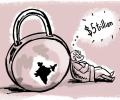
India decisively withstood global headwinds in 2023 and is likely to remain as the world's fastest-growing major economy on the back of growing demand, moderate inflation, stable interest rate regime and robust foreign exchange reserves. Despite widespread pessimism witnessed among the developed nations and the worsening geopolitical situation, India recorded a gross domestic product (GDP) expansion of 6.1 per cent in the March quarter. The growth moved up to 7.8 per cent in the June quarter and was 7.6 per cent in the September quarter. For the first six months of this fiscal, the growth was 7.7 per cent.

Morgan Stanley says, India will clock 7.9 per cent GDP growth in current fiscal.

Nirmala Sitharaman is proving to be a better finance minister than her initial rookie status might have led people to expect, observes T N Ninan.

Expenditure cuts necessitated by slowing revenue growth, weak industrial activity worrisome portents

The Nikkei India Manufacturing Purchasing Managers Index (PMI), fell from 52.1 in February to a five-month low of 51.0 in March, indicating the slowest improvement in operating conditions recorded by the survey since last October.

Corporate India handed over an average increment of 8 per cent in 2021, and early estimates reveal that average increment for 2022 is expected to increase to 8.6 per cent in line with a healing economy and improving confidence, according to a Deloitte survey. As per the second phase of Deloitte's Workforce and Increment Trends survey 2021, 92 per cent companies gave an increment in 2021 at an average of 8 per cent, compared with only 4.4 per cent in 2020, where just 60 per cent companies had extended a pay hike. For 2022, average increment is expected to increase to 8.6 per cent, at par with the pre-pandemic levels of 2019, the survey said, adding that about 25 per cent companies surveyed have projected a double-digit increment for 2022.

Fitch Ratings on Tuesday affirmed India's sovereign credit rating at 'BBB-' with a stable outlook, saying the rating derives strengths from the country's robust growth outlook and still-resilient external finances. It said India's robust medium-term growth outlook is a key supporting factor for the rating. A clear improvement in corporate and bank balance sheets, which were under strain prior to the pandemic, is likely to facilitate a steady acceleration in investment in the coming years.
One of the major contributors for the decline in growth will be the monsoon deficiency, which also affects non- agricultural sectors through demand effects, RBI report said.

Growth in India is expected to remain strong and stable in 2015
The wait for India to become a $5-trillion economic powerhouse by 2024-25 (FY25) is going to take longer than what the finance ministry had originally intended, according to the International Monetary Fund (IMF). The vision will instead be achieved in 2028-29 (FY29), reveals the IMF data, illustrating a four-year delay. Chief Economic Advisor (CEA) V Anantha Nageswaran had in February said India would become a $5-trillion economy by 2025-26 or the following year, on the back of 8-9 per cent sustained growth rate in real gross domestic product (GDP). However, the IMF data conveys that the economy will be $4.92 trillion in FY28, clearly alluding to the fact that the target will be realised in FY29.

India's economy is moving towards a higher growth trajectory and is likely to grow at around 10 per cent in 2021-22, Economic Advisory Council to the Prime Minister (EAC-PM) chairman Bibek Debroy said on Wednesday. "I am confident that we are on a path towards a higher growth trajectory, higher poverty reduction, higher employment, and a prosperous, more developed and better governed India. "I think it is, more or less, agreed that the real rate of growth this year (FY2022) is going to be around 10 per cent," Debroy said at an SBI event. At the beginning of FY2021-22, the forecasts for real growth were in the 8.5-12.5 per cent range, he noted.

The economists, who were surveyed, also felt it will take time for banks to make any further reduction in deposit rates

The Centre could better its fiscal deficit at 6.6 per cent of GDP in this financial year on stronger-than-expected revenue buoyancy, even if the budgeted disinvestment target is not met, Fitch Ratings has said. The international rating agency had last week kept the sovereign rating unchanged at 'BBB-' with a negative outlook, and said that the risks to India's medium-term growth outlook are narrowing with rapid economic recovery from the pandemic and easing financial sector pressures. In an email interview with PTI, Fitch Ratings Director (Asia-Pacific Sovereigns) Jeremy Zook said the two key positive triggers that could lead to a revision of the outlook to stable are implementation of a credible medium-term fiscal strategy to lower debt burden and higher medium-term investment and growth rates without the creation of macroeconomic imbalances, such as from successful structural reform implementation and a healthier financial sector.

Undeterred by the stock market volatility, uncertainty due to the Ukraine-Russia war and high inflation, equity mutual funds continue to remain attractive choice for investors for the 15th straight month, registering a net inflow of Rs 18,529 crore in May on robust SIP numbers. This was higher than Rs 15,890 crore net inflow in April, data from the Association of Mutual Funds in India (AMFI) showed on Thursday. Equity schemes have been witnessing net inflow since March 2021, highlighting the positive sentiment among investors.

Analysts and economists have hailed the fiscal projections in the interim Budget, saying the lower fiscal deficit forecast shows that the government, even in an election year, is serious about fiscal consolidation and that the numbers look achievable. According to Devendra Kumar Pant, the chief economist at India Ratings, the two broad themes of the interim Budget are fiscal consolidation and stepping up focus on agriculture/rural to course correct, to some extent, the differential benefits of the ongoing economic growth that's tilted in favour of upper-income bracket/urban households. The projected fiscal deficit numbers for FY24 and FY25 suggest that the government is serious about achieving the fiscal consolidation path of 4.5 per cent fiscal deficit by FY26, and given the nominal GDP growth assumption and revenue buoyancy, the target appears plausible, Pant said in a note.

Indian economy is expected to clock an average growth rate of 6.7 per cent till 2026-27 fiscal driven by domestic consumption, S&P Global Ratings senior Economist (Asia Pacific) Vishrut Rana said on Wednesday. He said the economic growth in the current fiscal is expected to come in around 6 per cent, lower than 7.2 per cent clocked in 2022-23. "We are seeing some headwinds from the trade side which is affecting activity and that is one of the factors that is affecting growth this year," Rana said at a webinar.

Equity benchmark Sensex declined over 215 points on Wednesday, weighed by losses in index heavyweight Reliance Industries, Bajaj Finserv and Tata Steel, after the Reserve Bank raised the key interest rate by 35 basis points. Subdued Asian markets and continued selling by foreign investors also weighed on sentiment, traders said. Extending its losses for the fourth straight session, the 30-share BSE Sensex ended 215.68 points or 0.34 per cent lower at 62,410.68.

Industrialists affirm their belief that the adverse effects of demonetisation and the goods and services tax are finally over.

The Indian economy remains on track to regain its position as the world's fastest-growing major economy after official estimates on Friday put the expansion at a tempered 9.2 per cent this fiscal amid concerns over the impact of a resurgent virus on the fragile recovery. The growth in the gross domestic product (GDP) of 9.2 per cent in April 2021 to March 2022 fiscal (FY 2021-22) given by the National Statistical Office (NSO) in its first advance estimate compares with 9.5 per cent expansion forecast by the Reserve Bank of India (RBI) last month. The economy had contracted by 7.3 per cent in the previous financial year.

India's exports declined by 2.83 per cent to $33.90 billion in November this year compared to $34.89 billion a year ago, government data released on Friday showed. Imports also declined to $54.48 billion in the month under consideration, as against $56.95 billion recorded in November 2022.

Public investment is very crucial for GDP growth, says finance ministry.

A rise in farm sector is estimated to raise demand for industrial goods and services, it added.

Ahead of the Union Budget for 2023-24, Budget makers have welcomed the global consensus view that India will remain one of the bright spots in calendar year 2023. But there is some alarm over the grim global situation and how that might impact the Centre's projections and assessments for next financial year. The big global headwinds include a deep and sustained recession in the West, including India's biggest trading partners in North America and Europe, continuing volatility in commodity markets, and renewed Covid-19 fears, as lifting of strict curbs by China could potentially lead to a massive spread again.

RBI said inflation in the second half of the current fiscal is projected at 2.7-3.2%. It retained its GDP forecast for the current fiscal at 7.4%

The GST will subsume excise, service tax, value added tax, octroi etc.

One could argue that India is not troubled in the same way as China is by a declining population and structural problems in real estate/construction and finance. But India has serious trade and fiscal imbalances, and excessive dependence on capital expenditure by the government, points out T N Ninan.

India's economy is likely to grow by 12 per cent in 2021 following a 7.1 per cent contraction last year, as near-term prospects have turned more favourable, Moody's Analytics said. A stronger than expected December quarter GDP growth of 0.4 per cent following a 7.5 per cent contraction in the previous three months has turned India's near-term prospects more favourable, it said. Domestic and external demand has been on the mend since the easing of restrictions, which has led to improved manufacturing output in recent months.

'It will take some more time because the affordability of these cars have changed drastically.'

Admitting that the economy may be impacted if the monsoon is inadequate, the government on Monday said the growth rate in 2009 will not fall to the levels being projected by international agencies like the IMF and the World Bank.

Market participants attribute the stability to the Reserve Bank of India's timely intervention in the foreign exchange market, both in terms of selling and buying dollars.
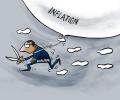
'If all goes well, we may well hit or even surpass the forecast growth rate.'

Bank of America Merrill Lynch on Monday trimmed India's economic growth estimates by 30 basis points to 7.1 per cent for the current fiscal, while global financial services giant Morgan Stanley downgraded its GDP growth forecast for the current fiscal to 7.3 per cent from the earlier 7.7 per cent.

At 5 per cent, Mumbai is likely to witness the highest rise in residential prices in 2024, a report released on Wednesday said. New Zealand's Auckland will also see a price rise of 5 per cent. According to real estate consultancy Knight Frank's "Prime Global Cities Index", improving gross domestic product (GDP) figures, Mumbai's relative value and investment in infrastructure will be the prime influencers in pushing prices higher for the luxury housing market in the city.

Shocks from Brexit could also hurt one of China's biggest export markets.

'We should look at is full year's growth rather than quarter numbers.'

Here are the key decisions announced by the Reserve Bank of India on Thursday.

TCS, Wipro and Infosys dropped by up to 4.47 per cent, dragging down the BSE IT index by 2.96 per cent

Budget-makers in North Block are looking to maintain this fiscal status quo, in spite of tax revenues nowhere close to where the government wants and in spite of possible higher expenditure commitments.

India will see a gradual growth acceleration with its GDP expected to reach 5.9 per cent this year.
